


I recently posted this on Twitter:
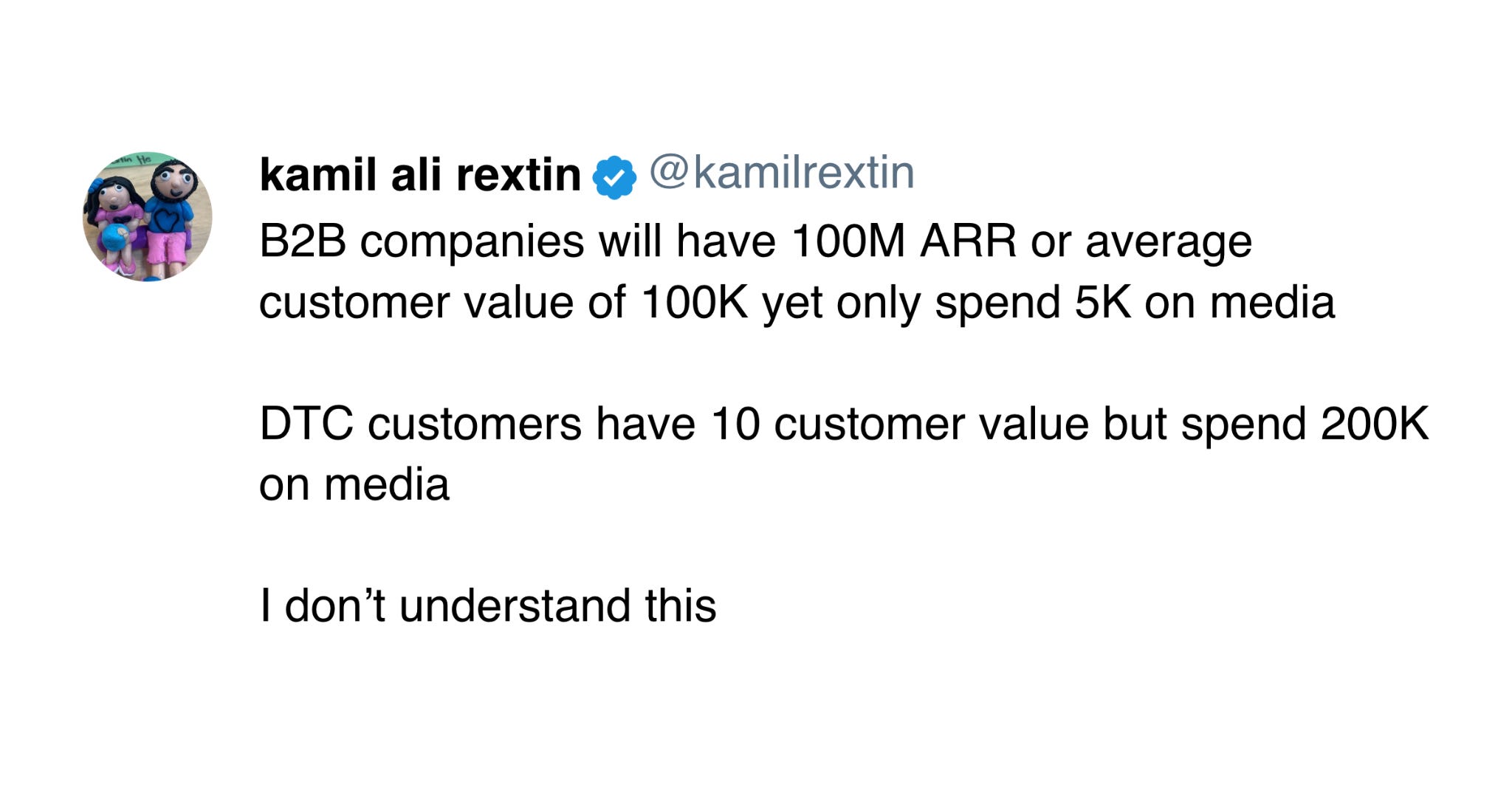
And I got some great responses. Mostly around how attribution is harder in B2B (which is true) and that B2B also invests in Sales (also true), but my point still stands.
You could hire an army of salespeople. But if you’re not investing in marketing, the pipeline just can’t scale. You can’t brute force your way out of the problem.
Here’s how I think about it:
With DTC, marketing is sales. The ad, the landing page, the checkout — that’s the entire funnel. Media in, revenue out. You can watch it happen in real time as the feedback loop is insanely short (they either buy or they don’t).
So, of course, they spend on media because media is the machine.
The same is true for self-serve or prosumer products like Notion:
Media does the heavy lifting
The product closes itself
The credit goes to the media, not a salesperson
The media drives people to sign up then the product flow gets them to upgrade. So the investment goes into media since it’s a clear and measurable business driver.
Enterprise is different. Sales is sales, marketing is marketing, and media is a sub-set of marketing. No-one is going to pull out their credit card and pay for 6 figure enterprise products without having at least one conversation first.
Which means the sale gets credited to the rep and the relationship, not to the media that convinced the buyer they were worth talking to.
Media gets treated as a support cost (or worse: not necessary), which leads to problems and misallocated investments.
How the buyer actually thinks
We assume the enterprise buyer needs information, which is why we drown them in documents and demos. But enterprise buying isn’t this simple. It’s a combination of bets and corporate theatre. The buyer can only get over the line once they’ve cleared three hurdles:
They get what you do
It feels like a safe bet
They trust you’ll still be here in three years
The buyer has to clear all three before signing. But in DTC, it can be an impulse buy based on a single click and a low price.
This isn’t possible with enterprise sales. You need to build trust, credibility, and familiarity before they will even consider buying from you. And how do you do this?
Media.
Media is the thing that creates the gap for sales to get in. But companies brush it off as brand awareness. So it has to compete with the swag budget instead of the sales team.
That’s why it only gets $5k.
You don’t need to outspend Notion
This is the part that confuses people…
The lesson from my tweet isn’t “spend like Notion”. Notion’s market is pretty much everyone, so they’re betting on reach. And reach at that scale costs $200M.
Luckily, you don’t have that problem. You’re not trying to reach everyone, you’re trying to reach a tiny fraction of everyone. You’re gunning for targeted saturation, where everyone in your very specific, hand-picked audience sees your media.
But just because your target audience is small, that doesn’t mean $5k comes even close to what you should be investing.
Let’s say your market is 1,200 companies, and there are, on average, 8 people on each company’s buying committee. That’s 9,600 people you’re trying to reach. Targeted saturation means being unavoidable to that defined few. You’re consistently everywhere they look, for the entire buying window.
The two or three podcasts they actually listen to, the newsletter they open, the events they show up to, the feeds they scroll, the billboard outside the office, etc.
You’re not trying to reach them in stereo. You want to reach them in surround sound. Wherever they turn, you’re all they hear.
It’s also worth remembering who you’re trying to reach. Enterprise buyers like CIOs, CFOs, CMOs, etc. are the most expensive people to reach. And the smaller and more niche your audience, the higher your CPM.
Just because it’s cheap and easy to look up the CIO of Walmart with Zoominfo, it doesn’t mean you can get their attention.
To get the attention of those 9,600 people, you’ll be spending somewhere in the six figures.
Top two easiest ways to blow your budget
As I’ve already covered, one way to flush your budget down the toilet is to think in terms of spend rather than saturation.
The second is not knowing where to invest your money.
In B2B, our default is LinkedIn ads. We hear the words “demand gen” and LinkedIn Campaign Manager automatically opens in our browser. It’s like a reflex we’re born with as marketers.
But plenty of your ICP aren’t reachable on LinkedIn. Lots of senior buyers barely open LinkedIn. They might log in a couple times a month to wade through the cold messages in their inbox and scroll the feed for a few minutes. They’re not doomscrolling every time there’s a quiet void to fill like us scumbags.
Instead, they listen to podcasts on the commute to work, read newsletters, go to conferences, watch YouTube, and drive past dozens of ads every day.
LinkedIn is just one place to reach them.
Targeted saturation isn’t possible if you put all your money in one place. It means being everywhere they actually are, whether they’re online or offline. The hard part is figuring out where your buyers actually spend their time, so you can show up in enough of those places. You’re trying to make yourself impossible to miss.
Most companies skip all that and buy LinkedIn because LinkedIn is easy to buy.
(We’ve written a lot about measurement, like our blog Attribution is Broken. Here is the Math That Replaces It)
Why CMOs don’t do this
The problem isn’t that CMOs don’t ‘get it’. Every CMO understands that the strength of your brand makes sales more efficient…in theory.
The problem is that they don’t want to stand in a boardroom and defend a number they can’t directly tie to the pipeline. It’s far more comfortable pointing to a graph where spend and sales both follow the same upward trajectory.
So the money goes to whatever channel is easiest to count, at the expense of everything else.
Marketing teams and agencies (us included) are under constant pressure to deliver short-term results. So we need to make sure the stakeholders and decision makers understand that you can’t have transactional marketing for a non-transactional product.
If it takes 6 months, multiple meetings, and a proof of concept to sell your product, how can you reasonably expect a single ad campaign to generate pipeline off a single click?
Recommended readings:
Brand is a performance lever

Editor’s note: This is the execution layer of our Brand vs. brand philosophy.
You’re Not Nike, and That’s the Point

Rocksalt released a report last month analyzing 7,000 LinkedIn posts. The finding that caught my attention: mentions of “brand building” are down 79%.
Marketing Measurement

There's a famous quote: Half the money I spend on advertising is wasted; the trouble is I don't know which half."